How to Identify a Plant by Leaf Shape: Simple Beginner Guide
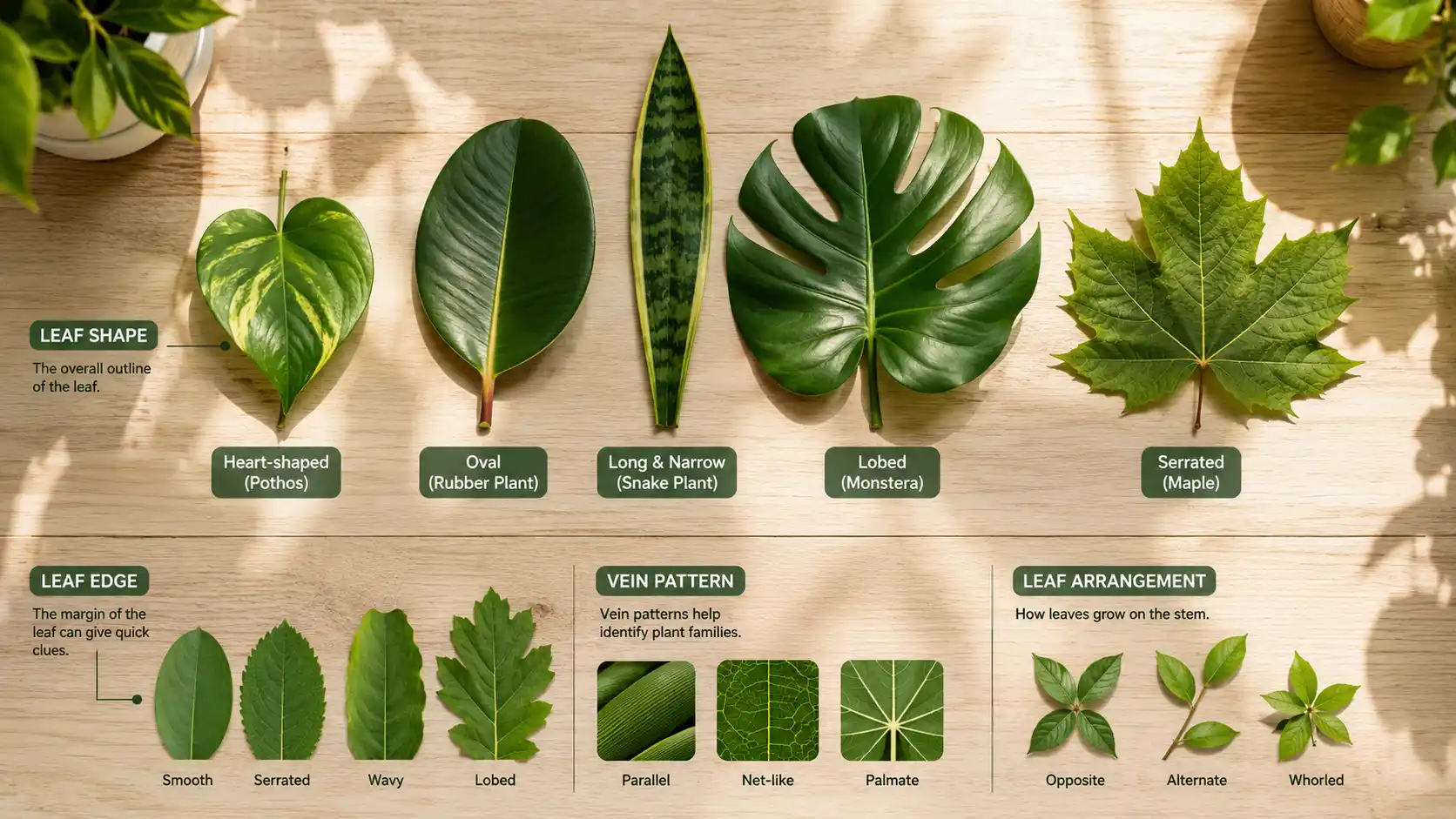
Trying to identify a plant by leaf shape is one of the easiest ways to start recognizing plants around your home, garden, or neighborhood. Leaves are visible for most of the year, and they often give strong clues about a plant's family, growth habit, and care needs.
In this beginner-friendly guide, you will learn how to use leaf shape, leaf edges, vein patterns, and leaf arrangement to narrow down plant identification before using a plant identifier app for confirmation.
Why Leaf Shape Helps With Plant Identification
Leaf shape is useful because many plants develop leaves in patterns that repeat across the species. While one feature is rarely enough for a perfect answer, combining several leaf clues can quickly remove wrong matches.
- Shape: Heart-shaped, oval, needle-like, long, round, or divided
- Margin: Smooth, serrated, wavy, lobed, or toothed edges
- Veins: Parallel, net-like, palmate, or feather-like patterns
- Arrangement: Leaves growing opposite, alternate, or in clusters
Common Leaf Shapes and What They Mean
Start by looking at the full outline of the leaf. Do not worry about botanical terms at first. A simple visual description is enough to begin.
| Leaf Shape | What to Look For | Common Examples |
|---|---|---|
| Heart-shaped | Wide leaf with a notch near the stem | Pothos, philodendron |
| Oval | Rounded sides with a soft tip | Rubber plant, peace lily |
| Long and narrow | Sword-like or strap-like leaves | Snake plant, spider plant |
| Lobed | Deep cuts or rounded sections along the leaf | Monstera, maple |
Check the Leaf Edges, Also Called Margins
The edge of a leaf can be one of the fastest clues. Hold the leaf still and look closely at the outline.
- Smooth edge: The leaf has a clean outline without teeth
- Serrated edge: The leaf looks saw-toothed
- Wavy edge: The margin curves in and out gently
- Lobed edge: The leaf has larger rounded or pointed sections
Helpful Hint: Take a clear photo of the leaf edge. A plant identifier works better when the leaf outline is sharp and not hidden by shadows.
Look at Veins and Leaf Arrangement
If two plants have similar leaf shapes, vein patterns and leaf placement can help separate them.
Leaf Vein Patterns:
- Parallel veins: Lines run side by side, common in grasses and many narrow-leaf plants
- Net-like veins: Small branching veins spread across the leaf
- Palmate veins: Several main veins start from one point, like fingers from a hand
- Pinnate veins: One main vein runs down the center with smaller side veins
Leaf Arrangement:
- Opposite: Two leaves grow across from each other on the stem
- Alternate: Leaves grow one by one at different points on the stem
- Whorled: Three or more leaves grow from the same point
How to Take a Good Leaf Photo for Plant Identification
A clear photo gives better results than a blurry or crowded one. Before uploading a leaf photo, try these simple steps:
- Place the leaf in natural light, but avoid harsh direct sun
- Keep the leaf edge visible from tip to base
- Take one close-up photo and one photo of the full plant
- Include flowers, fruit, stems, or bark if they are visible
- Avoid covering the leaf with your hand or plant pot
Final Thoughts
Learning plant identification by leaf is a practical skill for gardeners, houseplant owners, and anyone curious about the plants around them. Start with the leaf shape, then compare the edge, veins, and arrangement.
- Start with the overall leaf shape
- Check the margin and vein pattern
- Use a clear photo for better identification
Want to Identify a Leaf?
If you have a leaf photo and want a quick answer, use our free plant identifier website app. Upload your image and let the tool help you identify the plant.
Identify Your Leaf Now